
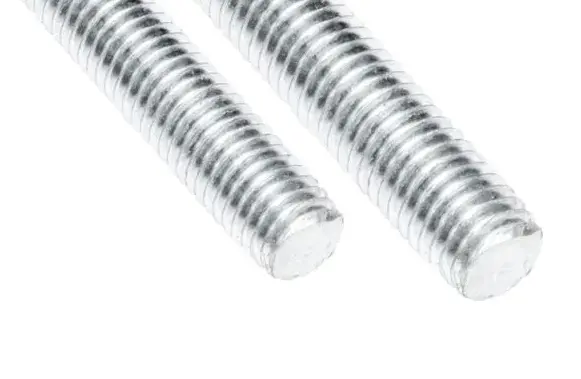
A booker rod is a fully threaded metal rod used for fastening, suspension, bracing, adjustment, and structural support. The term is commonly used in Australia and some construction markets to describe what is also called threaded rod, allthread, threaded bar, or studding.
Unlike a standard bolt, a booker rod has threads along most or all of its length. This allows nuts, washers, couplers, brackets, and other fittings to be positioned at different points on the rod.
Booker rod is widely used in construction, mechanical installation, electrical work, plumbing, HVAC systems, signage, steel fabrication, and general fastening applications.
Quick answer: what is booker rod used for?
| طلب | How booker rod is used |
|---|---|
| Pipe and cable suspension | Supports pipes, cable trays, and service systems from ceilings or steelwork |
| HVAC installation | Suspends ductwork, brackets, and equipment supports |
| Construction bracing | Connects, restrains, or supports selected building components |
| Signage | Supports signs, display panels, and suspended frames |
| Steel fabrication | Provides adjustable fastening between metal components |
| Furniture and fixtures | Connects table bases, frames, shelves, and custom assemblies |
| Formwork and temporary works | Used in selected adjustable fastening applications |
| General repairs | Creates a cut-to-length threaded fastening solution |
The correct booker rod must be selected according to diameter, thread type, material grade, coating, load requirement, environment, and approved installation method.
Booker rod, threaded rod, and allthread: are they the same?
In most construction and metalworking contexts, the terms refer to the same basic product: a long metal rod with continuous threads.
Common names include:
- Booker rod
- Threaded rod
- Allthread
- All-thread rod
- Threaded bar
- Studding
- Threaded stud
The naming can vary by country, supplier, industry, and project drawing. Before ordering, confirm the actual specification rather than relying only on the local product name.
How does a booker rod work?
A booker rod works by using threads to connect components with nuts, washers, couplers, brackets, anchors, or threaded inserts.
For example, a rod can be fixed to a ceiling anchor, pass through a support channel, and then be tightened with washers and nuts. The threaded length allows the installer to adjust the height or position of the supported item.
A simple installation may include:
- Anchor or support connection
- Booker rod
- Nut and washer
- Bracket, channel, or support member
- Second nut for locking or adjustment
The final assembly must be designed for the actual load and installation environment.
Common booker rod materials
Booker rods are available in different materials and finishes. The right option depends on strength, corrosion exposure, temperature, load, and project requirements.
| Material or finish | Typical use | Main consideration |
|---|---|---|
| Plain carbon steel | Indoor general fastening and fabrication | Requires protection in corrosive environments |
| Zinc-plated steel | Indoor dry environments | Limited corrosion protection |
| Hot-dip galvanized steel | Outdoor and humid construction environments | Useful where stronger corrosion resistance is needed |
| Stainless steel 304 | Many indoor, food-related, and moderately corrosive environments | Confirm suitability for the actual exposure |
| Stainless steel 316 | Marine, coastal, chemical, and highly corrosive environments | Often selected where improved corrosion resistance is required |
| High-tensile alloy steel | Higher-load fastening applications | Must match approved engineering and installation requirements |
Material selection should include the entire assembly, not just the rod. Nuts, washers, couplers, anchors, brackets, and support channels should also be compatible with the operating environment.
Common booker rod sizes
Booker rod is commonly supplied in metric and imperial sizes. Typical metric sizes may range from small-diameter rod for light-duty supports to larger-diameter rod for heavier fabrication and structural assemblies.
Frequently specified sizes include:
- M6
- M8
- M10
- M12
- M16
- M20
- M24
The required diameter should never be chosen by appearance alone. Load, rod length, thread condition, support spacing, fixing method, vibration, corrosion, and safety factor all affect the correct size.
Longer unsupported rods can bend, vibrate, or lose load capacity. A qualified engineer should specify the rod diameter, grade, spacing, and anchoring method for load-bearing or safety-critical work.
Booker rod versus a bolt
A booker rod and a bolt both use threads, but they are designed for different fastening needs.
| ميزة | Booker rod | Standard bolt |
|---|---|---|
| Thread length | Continuous or nearly continuous | Usually threaded only near one end |
| Head | No bolt head | Has a formed head |
| Length adjustment | Highly adjustable | Limited by bolt length and thread section |
| Cutting to length | Often possible | Less suitable |
| Common use | Suspension, bracing, custom fastening | Direct fastening of two or more components |
A booker rod is useful when the installation requires flexibility in length, adjustment, or multiple fastening points.
Booker rod versus an anchor rod
A booker rod is not automatically an anchor rod.
Anchor rods are designed or specified for connecting structural steel, equipment, columns, base plates, or other assemblies to concrete foundations. They may use specific materials, bends, plates, nuts, washers, embedded lengths, and installation requirements.
A general threaded rod should not be substituted for an engineered anchor rod unless the design engineer, project specification, and relevant approval process allow it.
For foundation, lifting, seismic, structural, safety-critical, or heavy-load work, use the exact rod grade and anchoring system specified by the project engineer.
Typical applications of booker rod
Mechanical, electrical, and plumbing support
Booker rod is often used to suspend cable trays, pipes, ductwork, conduits, lighting systems, and service supports. The rod provides a vertical connection between the structure above and the support system below.
The installation must account for:
- Total suspended load
- Support spacing
- Rod diameter
- Anchor type
- Fire-rating requirements
- Vibration
- Corrosion exposure
- Access for inspection and maintenance
HVAC and ductwork suspension
HVAC systems often use threaded rod together with channels, brackets, trapeze supports, clamps, and anchors. The rod allows installers to level and adjust the support height.
For vibration-sensitive equipment, the supporting system may also require approved vibration-isolation components.
Steel fabrication and bracing
In metal fabrication, booker rod can be used for adjustable bracing, frame connections, temporary assemblies, and fixture construction.
The material grade and thread quality should match the required load. High-tensile rod may be required where design loads exceed the capacity of standard mild-steel threaded rod.
Signs, ceilings, and suspended fixtures
Booker rod can support signs, ceiling systems, lighting, display structures, and architectural features. These applications require careful consideration of overhead-load safety, anchor capacity, redundancy, and local building requirements.
Never use an unverified rod-and-anchor assembly to support overhead loads.
Furniture and custom assemblies
Fully threaded rod is also used in furniture, table bases, shelving, display stands, workshop jigs, and custom metal assemblies. It is useful where a long adjustable connection is required.
How to choose the right booker rod
Before ordering, define the full application.
Ask these questions:
- What load will the rod support?
- Is the load static, dynamic, vibrating, or impact-related?
- What rod diameter is required?
- What thread standard and pitch are required?
- What material grade is specified?
- Is corrosion resistance required?
- Will the rod be used indoors, outdoors, near the coast, or in a chemical environment?
- What length is needed after installation?
- Which nuts, washers, couplers, and anchors will be used?
- Is the application structural, overhead, or safety-critical?
- Does the project require certificates, test reports, or traceability?
- Does a project engineer need to approve the assembly?
A proper quotation should identify size, material, finish, thread type, length, packaging, and quantity.
Important installation considerations
Correct installation is essential for booker rod performance.
- Use compatible nuts, washers, couplers, and anchors.
- Ensure threads are clean and undamaged.
- Do not use bent, heavily corroded, or damaged rod.
- Use approved anchors for the base material.
- Follow the required tightening procedure.
- Prevent galvanic corrosion when joining dissimilar metals.
- Protect cut ends if corrosion resistance is required.
- Use locking methods where vibration may loosen fasteners.
- Do not exceed the engineered load rating.
- Inspect overhead and safety-critical supports regularly.
A booker rod may look simple, but the safety of the complete assembly depends on the anchor, support structure, load path, installation quality, and environmental conditions.
خاتمة
A booker rod is a fully threaded metal rod used for adjustable fastening, suspension, bracing, and support. It is also widely known as threaded rod, allthread, threaded bar, or studding.
It is useful in construction, HVAC, electrical systems, plumbing, steelwork, signage, furniture, and general fabrication. The correct choice depends on rod size, material grade, thread type, corrosion resistance, load requirement, and approved installation method.
For booker rod specifications, threaded rod enquiries, or project purchasing support, contact Wuyang Metal.
FAQ
Is a booker rod the same as threaded rod?
Yes. Booker rod is a regional name for fully threaded rod, also called allthread, threaded bar, or studding.
What is a booker rod made from?
Booker rod may be made from carbon steel, high-tensile alloy steel, galvanized steel, stainless steel 304, stainless steel 316, or another specified material.
Can booker rod be used for structural support?
It can be used in selected structural or support applications only when the rod grade, diameter, load, anchor system, installation method, and engineering design are appropriate. Do not substitute general threaded rod for an engineered anchor or structural component without approval.
Can you cut booker rod to length?
Yes, booker rod can often be cut to the required length. After cutting, inspect the threads, remove burrs, and protect the cut end where corrosion resistance is important.
Post time: 09-30-2026


